


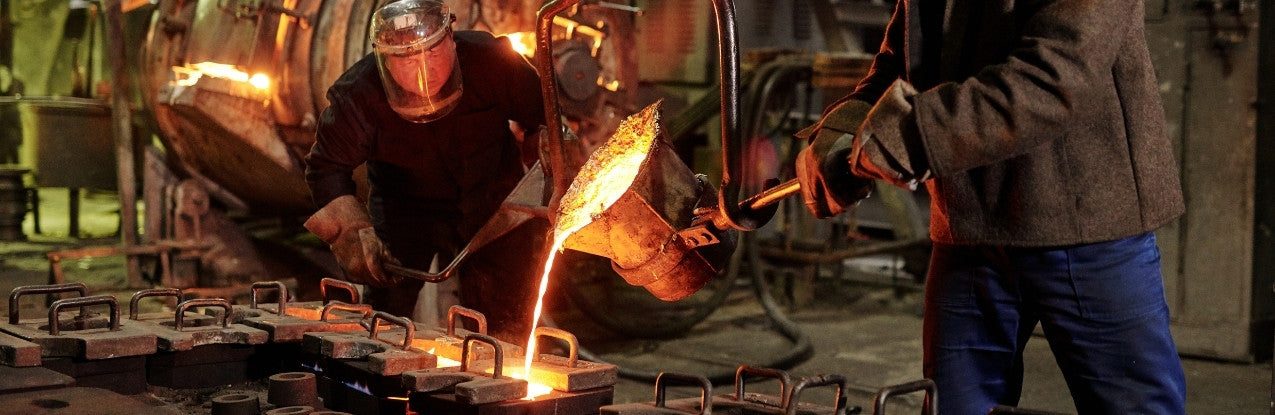
The melting point of iron is 1,538°C, the temperature at which pure iron becomes liquid. This high melting point is precisely why you don't melt but forge iron and steel: in a forge, you heat the metal well below that limit and deform it with a hammer.
The melting point of iron
The melting point of iron in degrees Celsius is 1,538°C, equivalent to 2,800°F or 1,811 Kelvin. This is the temperature at which pure iron transitions from a solid to a liquid state. If you continue to heat it, iron only reaches its boiling point around 2,862°C and evaporates.
Pure iron melts at one sharp temperature because all atoms share the same bond. In practice, you rarely work with completely pure iron: as soon as carbon or other elements are present, that boundary shifts. Remember 1,538°C as your fixed anchor point and calculate up or down from there for alloys.
Why does iron have such a high melting point?
Iron has such a high melting point due to the strong metallic bonds between the atoms in its crystal lattice. Iron is a transition metal with the symbol Fe and atomic number 26, and these atoms hold each other firmly. A lot of thermal energy is needed to break them apart and liquefy the metal.
The stronger the bonds in the lattice, the higher the temperature you need to reach. For comparison: lead, with much weaker bonds, is already liquid at 327°C. Iron requires almost five times as much heat.
This same robustness also explains why iron becomes soft and malleable long before it melts, something you as a blacksmith gratefully make use of.
How carbon affects the melting point of iron
Carbon strongly affects the melting point of iron: it lowers the temperature at which the metal becomes liquid. Pure iron melts at one fixed point, but as soon as you add carbon, a melting range rather than a sharp boundary is created.
This means that the metal does not change state at one specific moment but gradually softens and only then becomes liquid. The more carbon, the lower the temperature at which melting begins.
Which furnace reaches the melting point of iron?
No hobby furnace comfortably reaches the melting point of iron of 1,538°C, and there's no need for it. For forging, you heat steel to forging temperature, not melting temperature.
A gas-fired forge or a coal-fired forge will effortlessly bring you to the forging temperature you need, between 1,000 and 1,300°C.
If you want to work with iron yourself, forging is the way to go, not melting. You don't need to liquefy the metal: you heat it to forging temperature and shape it with a hammer on an anvil. If you don't have a workshop yet, a complete forging kit brings together the basics all at once, coordinated so you can start immediately.


