


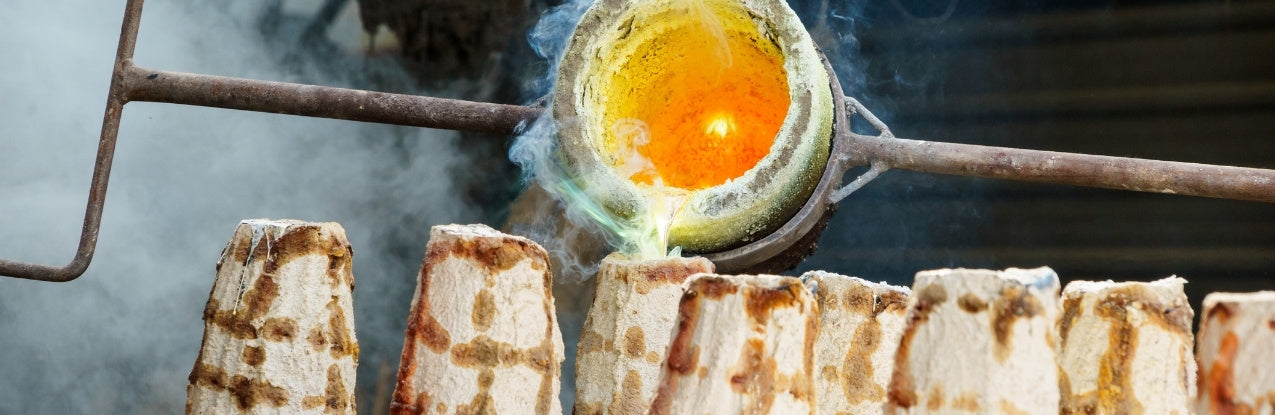
The melting point of brass is between 900 and 940 °C, depending on the alloy's composition. Brass is a mixture of copper and zinc and therefore does not have a fixed melting point, but a melting range.
If you want to melt and cast brass yourself, you need a melting furnace that reaches well above that range.
Why does brass have a melting range and not a fixed melting point?
Brass has a melting range instead of a fixed melting point because it is an alloy. With a pure metal, the transition from solid to liquid occurs at a single temperature, but with a mixture of copper and zinc, it happens gradually over a number of degrees.
The copper and zinc atoms do not separate at exactly the same time. A zone is created where the metal is partly solid and partly liquid until it is completely molten. That is why you always note a range for brass and not a single number.
Where that range lies exactly depends on how much zinc the alloy contains. Two types of brass with a different zinc content will therefore not melt at the same temperature.
Why is the melting point of brass lower than that of copper?
The melting point of brass is lower than that of copper because the added zinc lowers the melting temperature. Pure copper only becomes liquid at 1085 °C, while zinc melts at 420 °C.
If you mix the two, the melting point of the alloy drops to the range between 900 and 940 °C. In addition to the melting point, zinc also lowers the density and conductivity of copper, but makes the metal harder. Those who want to understand the behavior of copper as a base metal can find the full explanation in our article on the melting point of copper.
For the workshop, this means that brass requires less heat than pure copper. Your furnace therefore does not need to reach above 1085 °C to be able to cast brass.
How does zinc content affect the melting point of brass?
The zinc content determines where the melting point of brass falls within the range. The percentage of zinc in the alloy varies roughly between 5 and 45 percent, and this ratio controls both the melting temperature and the workability.
Alpha brass contains less than 40 percent zinc and is flexible enough to be cold worked. Beta brass has more zinc, is harder and stronger, but can only be hot worked. Above approximately 45 percent zinc, the alloy becomes too brittle for general use.
Other elements also play a role. An addition of lead, aluminum or tin shifts the melting range and adjusts properties such as strength and corrosion resistance. If you are working with a specific type of brass, look at the specified melting range and not at a general average.
Why do you melt brass and not forge it?
You work brass by melting and casting it, not by hot forging it like steel. The metal does not have a usable forging range in which it can be shaped under the hammer like steel without tearing.
Brass has good flow properties, which allows it to neatly fill the shape of a casting mold. This makes casting the logical route for parts and decorative work. Beta brass can still be hot worked, but for most makers, the emphasis is on casting.
With brass, it's therefore about the furnace and the crucible, and much less about the anvil. Those who want to shape brass heat it above its melting range and pour it out.
How do you melt brass in your own workshop?
To melt brass, you need a furnace, a crucible, and the right protection. Because brass only becomes liquid between 900 and 940 °C, your furnace must be able to reach well above that range. A gas-fired melting furnace reaches that temperature and keeps the metal liquid during casting.
You melt the brass in a crucible that can withstand this heat, with enough margin above the melting range. The liquid metal is then poured into a graphite or sand mold, which you can find under casting molds. Note that zinc at melting temperature comes close to its boiling point: if you overheat the brass, the zinc volatilizes as white vapor and the composition changes.
Therefore, always work in a well-ventilated area and keep the temperature just above the melting range. Use heat-resistant gloves and safety glasses, as liquid brass radiates heat and splashes.
Are you going to cast brass yourself? At Parrot Shopping, you will find melting furnaces, crucibles, and casting molds to safely get started with brass. Our team will assist you as your guide in the forging trade.


