


The melting point of bronze is not a single fixed temperature, but between approximately 850 and 1000°C, depending on the composition. Standard bronze with about 15% tin becomes liquid around 950°C. If you plan to cast yourself, this range determines which melting furnace you need.
Why does bronze have a melting range instead of a single melting point?
Bronze has a melting range because it is an alloy of copper and tin, not a pure metal. Pure metals melt at an exact temperature, but an alloy does so over a range.
At the bottom of that range is the solidus: the point where the bronze begins to melt. At the top is the liquidus, where it is completely liquid. Between the two, the bronze is partly solid and partly liquid. This range determines how smoothly the metal flows during casting.
How does the tin content affect the melting point of bronze?
The tin content lowers the melting point of bronze: the more tin, the lower the temperature at which it melts. If you add 5% tin to copper, the melting point drops from 1085°C to about 1050°C. With 15% tin, it drops further to around 960°C.
This explains why bronze is easier to cast than copper itself. Pure copper only melts at 1085°C, while tin becomes liquid at 232°C.
What is the melting point of different types of bronze?
The melting point of bronze varies by type, because each bronze alloy contains different elements besides copper and tin. The three types you encounter most often in the workshop are tin bronze, aluminum bronze, and silicon bronze.
Melting point of tin bronze
Tin bronze melts between approximately 850 and 1000°C, with around 950°C as a guideline for a 15% tin content. This is the classic bronze alloy of copper and tin. The higher the tin content, the lower the melting point and the better the metal flows into the mold.
Melting point of aluminum bronze
Aluminum bronze melts between approximately 1030 and 1040°C. Instead of tin, it contains between 6 and 12% aluminum, which makes it strong and corrosion-resistant. Due to this higher melting point, aluminum bronze demands more from your furnace and your patience.
Melting point of silicon bronze
Silicon bronze has a melting point of approximately 1025°C and contains a small amount of silicon in addition to copper. It combines good castability with corrosion resistance. For beginners, silicon bronze is pleasant because it flows cleanly and evenly.
What temperature do you need to melt bronze?
To melt bronze, you need a temperature well above the melting point, often between 1050 and 1150°C depending on the alloy. Bronze is tough and viscous, so you heat it further than just the melting point to make it flow well.
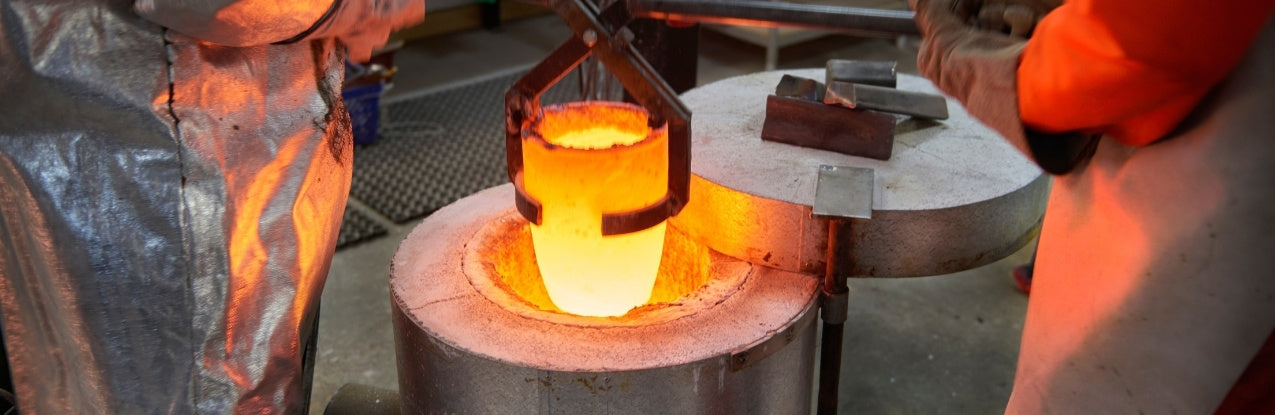
A furnace that remains stably above 1000°C is the basis for this. The molten metal is collected in a crucible made of refractory material, which can withstand the high temperature. Also, preheat your mold so that the bronze does not solidify too quickly as soon as you cast.
Getting started with bronze casting yourself
Bronze casting begins with the right equipment and a little patience. As a beginner, you don't have to find everything separately.
A complete melting kit contains the furnace, crucible, and mold you need to get started. This way, you work step-by-step towards your first casting, with the guidance you can expect from your guide in the smithing trade.


